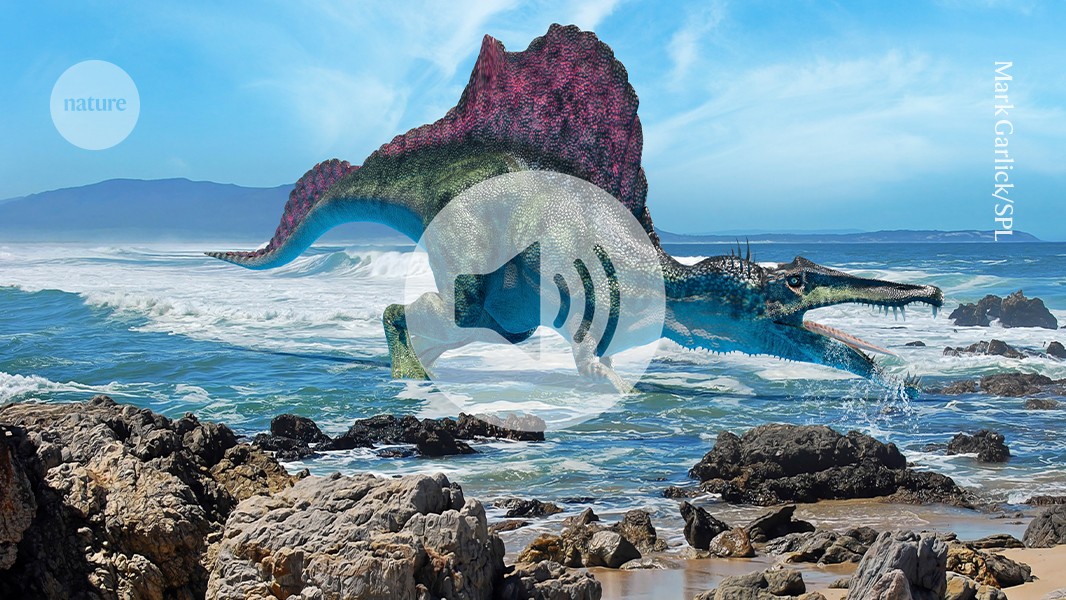
Your image of the spinosaurus—that sail-backed, crocodile-snouted dinosaur—is about to get a salty upgrade. A new study published today in Nature reveals that these ancient predators possessed salt glands, a specialized adaptation for excreting excess salt, strongly suggesting they lived in marine environments. This discovery reshapes our understanding of dinosaur ecology and evolution, and offers unexpected lessons for human health optimization, particularly in electrolyte balance and hydration.
The Science Behind the Discovery

Researchers from the University of Cambridge and the Natural History Museum in London analyzed spinosaur skulls from the Cretaceous period using high-resolution computed tomography (CT) scans. The images revealed cavities and channels in the nasal and frontal bones consistent with salt glands—organs that filter and expel salt from the bloodstream. These structures are remarkably similar to those found in modern seabirds like albatrosses and marine reptiles like sea turtles, which use them to drink seawater without dehydrating.
The fossils date back approximately 100 million years, a time when sea levels were significantly higher and vast inland seas covered much of what is now Europe and Africa. The identification was confirmed through detailed morphological analysis and machine learning algorithms that distinguished biological structures from fossilization artifacts. The glands are located in the nasal region, with ducts draining into the nostrils, allowing excretion of a concentrated salt solution.
The presence of salt glands indicates that spinosaurs spent significant time in saltwater, likely hunting fish, sharks, and other marine prey. Previous debates centered on whether these dinosaurs were primarily terrestrial or aquatic; now, the anatomical evidence strongly supports a semi-aquatic, marine lifestyle. This is the first time salt glands have been documented in any dinosaur, making spinosaurs a unique case of convergent evolution with modern marine animals that face the same osmotic challenge.
“This finding transforms our understanding of the spinosaur's ecological niche, showing they conquered Cretaceous seas in a way no other dinosaur did.”
Key Findings
- Salt glands confirmed: CT scans reveal cavities in spinosaur skulls that housed salt-excreting glands, an adaptation never before seen in dinosaurs. The glands are located in the nasal region with ducts leading to the nostrils for salt excretion.
- Marine habitat: The presence of these glands indicates spinosaurs lived in saline environments, likely coastal or marine, challenging the view of dinosaurs as exclusively terrestrial. They were likely apex predators in marine ecosystems, similar to modern saltwater crocodiles.
- Precise dating: The analyzed fossils are approximately 100 million years old, from the Cretaceous period when sea levels were higher and inland seas created extensive coastal habitats.
- Evolutionary convergence: Spinosaur salt glands are anatomically similar to those of modern seabirds and marine turtles, a striking example of parallel evolution. This demonstrates that natural selection favors similar solutions to common physiological problems.
- Ecological implications: Spinosaurs likely occupied a niche similar to modern large marine predators like sharks, and their presence in coastal ecosystems may have influenced Cretaceous food web dynamics.

Why It Matters: Implications for Science and Health
This discovery is more than a paleontological curiosity; it has profound implications for understanding prehistoric ecosystems and how species adapt to extreme environments. Spinosaurs were apex predators in their habitats, and their ability to exploit marine resources suggests that Cretaceous coastal ecosystems were more complex than previously thought. Moreover, this adaptation may have allowed them to survive environmental changes that affected other dinosaurs, such as sea level fluctuations and salinity changes.
For health and biohacking enthusiasts, this finding is a reminder of how evolution solves physiological challenges. Salt glands are an efficient mechanism for maintaining water balance in saline environments, a challenge humans also face in extreme conditions like heat dehydration, intense exercise, or seawater exposure. Understanding these adaptations can inspire approaches to hydration and electrolyte management for athletes, intermittent fasters, or those exposed to adverse conditions.
Furthermore, the study opens the door to investigating whether other aquatic dinosaurs, such as plesiosaurs or mosasaurs, also possessed salt glands. This could change our understanding of marine reptile evolution and their relationship to dinosaurs. The CT scanning technique used here could be applied to other fossils to detect similar adaptations, revolutionizing paleontology.
Your Protocol: Lessons from Spinosaurs for Your Health

While you can't grow salt glands, you can apply evolutionary principles to your daily health. Here's a practical protocol based on adaptation to saline environments:
- 1Optimize hydration with balanced electrolytes: Just as spinosaurs eliminated salt to conserve water, you need to balance sodium and potassium, especially if you sweat heavily, exercise intensely, or follow a low-carb diet. Consider sugar-free electrolyte supplements like sodium, potassium, and magnesium tablets. Drink water with a pinch of sea salt and lemon to replenish electrolytes naturally.
- 2Adapt your diet to your environment and activity level: If you live in a hot climate or exercise intensely, increase water and mineral intake. Spinosaurs teach us that adaptation to environment is key to survival. Monitor your sweat: if you see white salt stains on your clothes after a workout, you're losing electrolytes and need to replenish. Include potassium-rich foods like bananas, avocados, and spinach.
- 3Monitor your water balance with modern tools: Use wearables that track hydration or simply observe urine color (should be pale yellow). Maintaining proper balance improves cognitive and physical performance. If you practice intermittent fasting, pay special attention to electrolytes, as reduced carbohydrate intake can cause sodium loss. Consider adding a pinch of salt to your meals or drinks.
- 4Apply the stress-adaptation principle: Just as spinosaurs developed salt glands in response to a saline environment, your body can adapt to controlled stressors. For example, heat exposure (sauna) or cold exposure (cold showers) can improve your tolerance and physiological efficiency. Always proceed gradually and with caution.
What To Watch Next: The Future of Research
Researchers plan to search for salt glands in other dinosaurs, such as spinosaurs from other regions (e.g., Spinosaurus aegyptiacus from Africa) and other aquatic theropods. Isotopic studies on spinosaur teeth are also expected to confirm their consumption of marine prey, analyzing oxygen and strontium isotope ratios. If these results are replicated, we could be facing a major revision of dinosaur evolutionary history, showing that the conquest of the sea was more common than previously thought.
Moreover, the use of CT scanning in paleontology is revolutionizing the field. Each year, new technologies reveal anatomical details that were previously invisible, such as fossilized soft tissues or internal structures. This could lead to similar discoveries in other species, expanding our knowledge of prehistoric life and its adaptations. The combination of artificial intelligence with medical imaging promises to accelerate these findings even further.
The Bottom Line
Spinosaurs had salt glands, proving they lived in marine environments and were apex predators adapted to saltwater. This finding, published in Nature on June 5, 2026, changes our view of these dinosaurs and underscores the importance of physiological adaptations in evolution. For health seekers, remember: nature has ingenious solutions to ancient problems. Apply those principles to your daily life, optimize your hydration and electrolyte balance, and become a 'modern spinosaur' adapted to your environment.

:format(jpg):quality(99):watermark(f.elconfidencial.com/file/a73/f85/d17/a73f85d17f0b2300eddff0d114d4ab10.png,0,275,1)/f.elconfidencial.com/original/9e9/55d/e0f/9e955de0fef0dc6a774c625b1c8718f9.jpg)