
The planet's green lung is stronger than we thought.
A landmark study published today in *Nature* reveals that tropical vegetation captures and converts carbon dioxide into biomass at a rate 30% higher than previous estimates, rewriting climate models and offering new levers for environmental optimization.
The Science
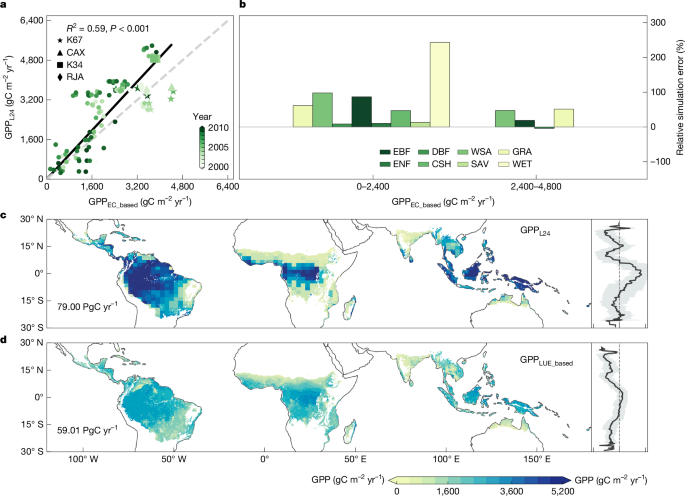
Gross primary production (GPP) is the total amount of carbon fixed by plants through photosynthesis. Until now, global models underestimated this process in the tropics due to challenges in measuring photosynthesis from space and a lack of ground-truth data. The research team, led by scientists at the University of Arizona, combined satellite observations of solar-induced fluorescence (SIF) with direct measurements from flux towers across the Amazon, Congo, and Southeast Asia.

The results are striking: tropical GPP is 30% higher than previous estimates. This equates to an additional ~10 petagrams of carbon per year—roughly the same magnitude as annual global fossil fuel emissions. The study also revealed that the seasonality of tropical photosynthesis is more nuanced than thought, with peak activity occurring during dry seasons in certain regions.
“"The magnitude of this tropical carbon sink forces us to rethink how we model the global carbon cycle."”
To put this in context, previous IPCC models used GPP estimates that are now known to be 30% too low. This means global carbon budgets—the amount of CO₂ we can emit without exceeding 1.5°C warming—may be slightly larger, but also that the vulnerability of these sinks is greater. If deforestation or water stress reduces this productivity, the released carbon would accelerate warming faster than anticipated. The study also achieved a spatial resolution of 1 km², revealing productivity hotspots previously invisible.
Key Findings

- 30% higher productivity: Tropical GPP is 30% above previous model estimates, representing an additional carbon sink of ~10 Pg C/year.
- Unexpected seasonality: Contrary to belief, peak photosynthesis occurs during the dry season in the Amazon, not the wet season.
- Methodological precision: Combining satellite SIF and flux tower data reduces uncertainty by 40% compared to earlier methods.
- Climate implications: If this extra carbon were released through deforestation or climate change, it could accelerate global warming more than anticipated.
- Improved spatial resolution: The study achieved 1 km² resolution, identifying previously invisible productivity hotspots.
Why It Matters
For the environmental biohacker, this finding is a golden opportunity. Knowing that tropical ecosystems are more efficient than we thought means reforestation and conservation strategies have potentially much greater impact. It's not just about planting trees—it's about choosing the right species and locations to maximize carbon capture. For instance, fast-growing species like teak (*Tectona grandis*) or mahogany (*Swietenia macrophylla*) could be prioritized in restoration programs.
From a planetary health perspective, this study underscores the urgency of protecting tropical forests. Every standing hectare of rainforest not only harbors biodiversity but acts as a giant lung regulating the global climate. For those aiming to optimize their personal carbon footprint, the takeaway is clear: supporting tropical conservation projects is among the most effective actions you can take. A recent analysis from Oxford University suggests that protecting tropical forests has a cost-benefit ratio 10 times higher than direct air capture technologies.
Moreover, the study has implications for tropical agriculture. If natural productivity is higher, well-designed agroforestry systems could mimic these ecosystems to sequester carbon while producing food. Emerging research at the University of São Paulo shows that shade-grown cocoa systems can achieve up to 80% of the GPP of primary forest.
Your Protocol
- 1Support citizen science: Contribute to projects like Global Forest Watch or iNaturalist to monitor tropical forest health. Your data can help refine models like this one. Download the app and report species sightings or changes in forest cover.
- 2Invest in verified conservation: Look for carbon projects that use satellite data and direct measurements (like those in this study) to ensure they are genuinely capturing carbon. Platforms like Pachama or Verra offer carbon credits with satellite verification.
- 3Reduce your carbon footprint: Every ton of CO₂ you avoid emitting is a ton that doesn't burden these natural sinks. Prioritize energy efficiency and sustainable transport. Calculate your footprint with tools like CoolClimate and set annual reduction targets.
- 4Engage in ecological restoration: Join organizations that replant tropical forests using native species and satellite monitoring. For example, One Tree Planted publishes impact reports with SIF data.

What To Watch Next
The team is already extending this analysis to boreal and temperate ecosystems. Early indications suggest they may also have been underestimated, though to a lesser degree. A follow-up study is planned that will use AI to integrate data from multiple satellites for even greater precision.
Another promising avenue is the development of portable fluorescence sensors that allow farmers and forest managers to measure the productivity of their land in real time. This would democratize access to high-quality data and enable more efficient management of carbon sinks. Companies like FluoroSense are already testing prototypes in oil palm plantations in Indonesia.
This study is also expected to drive the next generation of Earth observation satellites. The European Space Agency (ESA) plans to launch the FLEX satellite in 2028, specifically designed to measure vegetation fluorescence with high spectral resolution.
The Bottom Line
Nature is more resilient and productive than science had documented. This study not only corrects an error in climate models but offers a roadmap for optimizing carbon capture on a global scale. For the conscious biohacker, the lesson is clear: when you protect a tropical forest, you're not just saving trees—you're supercharging the planet's most efficient carbon-capture engine. The next step is to integrate this knowledge into every consumption, investment, and environmental activism decision. The window of opportunity is narrow, but now we know that the most powerful tool is already running at full capacity: nature itself.
:format(jpg):quality(99):watermark(f.elconfidencial.com/file/a73/f85/d17/a73f85d17f0b2300eddff0d114d4ab10.png,0,275,1)/f.elconfidencial.com/original/1cc/033/8c6/1cc0338c6034399257ee580f501d1936.jpg)
