
Your smartwatch and meditation app are just the beginning. The next frontier in health optimization won't come from a wearable—it will come from a quantum computer. And the progress, though incremental, is accelerating. Over the past few years, quantum computing has moved from a laboratory curiosity to a tangible promise for transforming entire industries. For health and longevity, this technology represents a paradigm shift: the ability to simulate molecules and biological processes with a precision that is impossible today. While classical computers process bits that are either 0 or 1, quantum computers use qubits that can be 0, 1, or both at once due to superposition. This allows them to explore multiple solutions simultaneously, which is crucial for complex problems like protein folding or drug-receptor interactions.
The Science
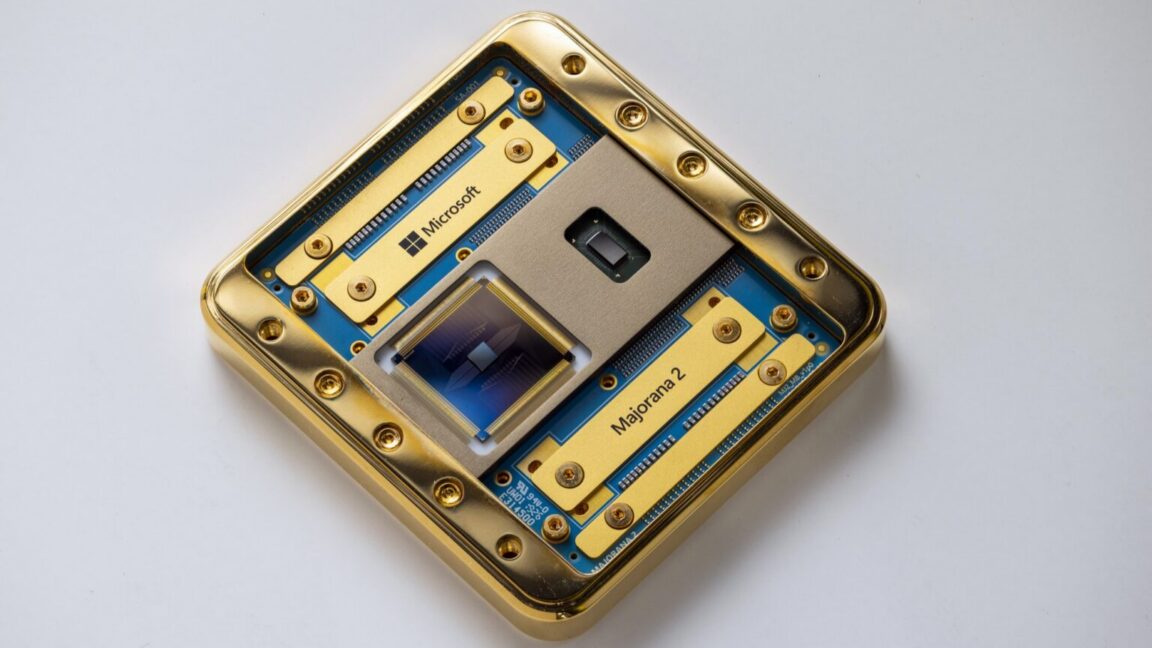
Microsoft, alongside Atom Computing and EeroQ, just released updates on their quantum computing progress. While none of these are headline breakthroughs, they represent the essential groundwork needed to make quantum computers useful. Microsoft is one of the few companies pursuing topological qubits, which rely on exotic physics when particles are confined. Their system uses a thin superconducting wire placed on top of a semiconductor. In superconductors, electrons form Cooper pairs, but if the wire has an odd number of conducting electrons, one unpaired electron becomes delocalized to both ends of the wire. This quantum weirdness creates qubits that are inherently more stable and less error-prone. Stability is the Achilles' heel of quantum computing: conventional qubits are extremely sensitive to environmental noise, causing errors in calculations. Topological qubits, being protected by topological properties, are inherently more robust. This means they could operate with less error correction, reducing the number of physical qubits needed for a useful logical qubit. Microsoft has been working on this approach for years, and although they have not yet demonstrated a fully functional topological qubit, their recent advances indicate they are closer than ever.

“The stability of topological qubits could be the key to practical quantum computers within the next decade.”
Key Findings

- Topological qubits: Microsoft is one of the few companies pursuing this approach, based on confined particle physics, promising greater stability. Unlike superconducting or trapped ion qubits, topological qubits use quasiparticles called non-abelian anyons, which exist in two-dimensional systems. Manipulating these anyons allows for more robust quantum operations. This approach, though more complex to implement, could drastically reduce error rates.
- Incremental progress: The reported advances are necessary steps, not revolutions. Each one brings the technology closer to general utility. For example, Microsoft demonstrated the ability to detect and control Majorana modes, which are the basis for topological qubits. While not a complete qubit, it is a critical milestone. Atom Computing, meanwhile, has made advances in neutral atom qubits, which offer scalability and long coherence times. EeroQ focuses on qubits based on electrons on liquid helium, another promising alternative.
- Industry cooperation: Atom Computing and EeroQ also presented updates, showing a diverse ecosystem advancing in parallel. This diversity is healthy: different architectures may be optimal for different applications. For instance, Google and IBM's superconducting qubits are suitable for certain algorithms, while topological qubits might be better for long, complex calculations. Collaboration between companies and academic labs accelerates overall progress.
Why It Matters
For the biohacker or longevity enthusiast, quantum computing isn't an abstract concept. It means molecular simulations that are impossible today: modeling protein folding, designing anti-aging drugs, or personalizing treatments in minutes instead of years. While classical computers hit a wall with biological complexity, quantum computers can process billions of states simultaneously. Microsoft's research into topological qubits, if successful, would provide the stability needed for long, complex calculations—exactly what's needed to unlock the biology of aging. Imagine being able to simulate the interaction of a new compound with every protein in the human body in a matter of hours, something that would take years today. Or designing personalized gene therapies based on an individual's complete genomic profile. Quantum computing could also revolutionize research into complex diseases like Alzheimer's or cancer, where molecular interactions are too complex for current computers. Companies like Biogen are already exploring partnerships with quantum firms to accelerate drug discovery.
Your Protocol

While you can't buy a quantum computer yet, you can prepare for the shift it will bring:
- 1Follow the science: Keep an eye on companies like Microsoft, Atom Computing, and EeroQ. Their milestones signal when quantum computing will start impacting health. Subscribe to quantum news newsletters, follow key researchers on social media, and attend virtual conferences. Understanding the milestones will help you anticipate when the first practical applications become available.
- 2Invest in data: Personalized medicine requires genomic and health data. The more you complete your profile (blood work, microbiome, etc.), the more you'll benefit when quantum algorithms analyze your biology. Consider getting a full genome sequencing (if affordable) and maintaining a detailed record of your biomarkers. Digital health companies already offer data analysis services that could integrate with quantum platforms in the future.
- 3Strategic patience: Practical applications are still years away. Use this time to build a solid health foundation—sleep, nutrition, exercise. When the quantum revolution arrives, you'll be ready to leverage it. Additionally, keep an open mind to new therapies and technologies that may emerge from quantum research. Longevity is a marathon, not a sprint.

What To Watch Next
Upcoming milestones include Microsoft demonstrating a functional topological qubit, and integrating multiple qubits into larger systems. Atom Computing and EeroQ are also close to their own achievements. The convergence of these technologies could accelerate timelines. Watch for announcements of collaborations with pharmaceutical or biotech companies—these will be signals that quantum computing is beginning to be applied to health. For instance, if Microsoft announces a partnership with a major pharma company to simulate molecular interactions, we'll know the technology has matured. It's also important to follow advances in quantum error correction, as it is a critical bottleneck. IBM's roadmap toward 1000 logical qubits by 2030 is a key indicator. In the longevity space, pay attention to startups combining quantum AI with synthetic biology; they might be the first to offer anti-aging therapies based on quantum simulations.
The Bottom Line
Quantum computing is advancing step by step. Microsoft, with its topological qubits, and other companies are building the foundation for a tool that will transform medicine and longevity. While practical benefits are still years away, each update brings us closer to a future where we can understand and optimize human biology at an unprecedented level. Stay informed and prepare your health for that leap. The combination of comprehensive personal data and quantum computing power could be the key to extending healthy lifespan in ways we can barely imagine today. It's not just about living longer, but living better, with precise, personalized interventions that address the root causes of aging.