
A human cranium emerged from coastal erosion at Loch Borralie in northwest Scotland in 2000. Inside, there was no brain. But archaeologists now know someone intentionally removed it over two thousand years ago. This finding doesn't just rewrite what we thought about Iron Age British funerary practices—it opens questions about how ancient cultures understood death and the human body.
The Science
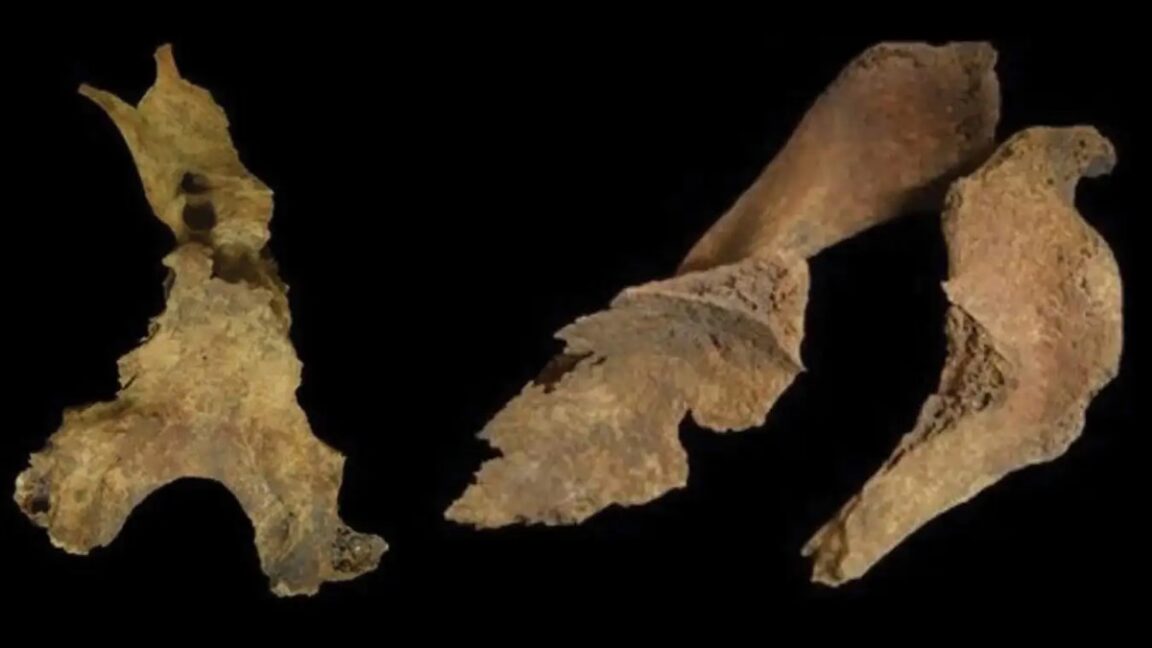
The study, published in *Antiquity*, analyzed remains of two individuals found in a burial cairn: an adult female and a juvenile of indeterminate sex. Radiocarbon dating of their molar teeth placed their deaths between 50 BCE and 70 CE, right at the boundary between the Iron Age and Roman occupation of Britain. Researchers applied osteoarchaeological analysis, multi-isotope analysis, and ancient DNA to reconstruct their story.

The key evidence was an unusual fracture at the base of the adult female's skull, occurring near the time of death. According to the authors, this break pattern doesn't match common accidents or falls but suggests a targeted high-velocity impact. They also found perimortem fractures on both scapulae. Everything points to deliberate postmortem manipulation, possibly to remove the brain.
“The finding of a skull fracture from a targeted impact and the modification of long bones suggests Iron Age Britons practiced defleshing and reuse of human remains as tools.”
Key Findings

- Precise dating: The remains date between 50 BCE and 70 CE, based on radiocarbon analysis of molars.
- Atypical skull fracture: The female's cranium base shows a fracture pattern from high-velocity impact, not consistent with typical accidents.
- Bone modification: Sharpened limb bones were found, possibly repurposed as tools.
- Two individuals, same treatment: Both the adult female and juvenile show evidence of postmortem manipulation.
- Unique preservation context: Northwest Scotland's environment allowed bone preservation that would have been lost elsewhere.

Why It Matters
This discovery challenges the notion that ancient Britons simply buried their dead. Brain removal and bone reuse indicate a complex relationship with the deceased body, perhaps for ritual or practical purposes. For biohackers and longevity enthusiasts, such findings remind us that body manipulation isn't new—from trepanation to mummification, our species has always sought to control the decomposition process.
Moreover, isotope and ancient DNA analysis could reveal diet, migration, and kinship patterns. Although the study didn't find evidence of specific diseases, soft tissue preservation in Scotland opens the door to future microbiome or ancient pathogen analysis.
Your Protocol
While you won't be extracting brains from your ancestors, you can apply the same principle of rigorous investigation to your own health. Osteoarchaeology teaches us to read the signals time leaves on bones; you can read the signals your lifestyle leaves on your body.
- 1Examine your own markers: Just as archaeologists use isotopes, you can use blood work, DEXA scans, or genetic tests to understand your bone and metabolic health.
- 2Protect your skull: Impact fractures are a reminder to guard your head. Wear helmets in risky sports and seatbelts in cars.
- 3Learn from the past: Ancient funerary practices show death has always been part of human optimization. Reflect on your physical legacy: organ donation, scientific research.
What To Watch Next
The research team plans to expand ancient DNA analysis to determine the juvenile's sex and possible family relationships. They also hope to find more remains in the region to compare funerary practices. Future studies could detect pathogens or parasites in preserved tissues, offering a window into Iron Age health.
The Bottom Line
Brain removal in Scotland 2,000 years ago isn't just an archaeological curiosity—it's a reminder that human body manipulation has deep roots. For the modern biohacker, the lesson is clear: every bone, every fracture, every ancient practice contains information we can use to understand our own biology. The past isn't dead; it's just waiting to be interrogated.
Broader Context: Implications for Longevity
This finding adds to growing evidence that prehistoric societies performed complex bodily interventions. Trepanation, for example, was practiced in many ancient cultures, and some individuals survived the surgery. The brain removal documented here may parallel practices of mummification or trophy head-taking. For longevity researchers, understanding how ancient cultures managed decomposition offers clues about human biological plasticity. Moreover, ancient DNA analysis could reveal genetic variants associated with disease resistance or longevity, providing evolutionary context for modern health.
Future Directions
The research team plans to sequence the full genome of both individuals to look for markers of hereditary diseases or local adaptations. Strontium and oxygen isotope analysis is expected to reveal migration patterns. Combined with paleopathology studies, these data could offer an unprecedented view of Iron Age health and lifestyle. For the biohacker community, this underscores the importance of integrating genetic, dietary, and environmental data to optimize health.
Practical Protocol for the Reader
Based on osteoarchaeological principles, here is a three-step protocol to apply to your own health:
- 1Assess your bone density: Get a DEXA scan if you have risk factors like advanced age, menopause, or family history of osteoporosis. Strong bones are the foundation of a long, active life.
- 2Monitor your inflammation: Just as archaeologists look for signs of infection in bones, you can measure inflammatory markers like C-reactive protein (CRP) in blood tests. Chronic inflammation accelerates aging.
- 3Optimize your microbiome: Tissue preservation in Scotland might one day reveal ancient bacteria. Today, you can nurture your microbiome with a diet rich in fiber, probiotics, and prebiotics, which is associated with better immune health and longevity.
Conclusion
Brain removal in the Iron Age is not just a curious fact—it is a testament to humanity's long history of body manipulation. Every archaeological finding reminds us that the body is an archive of information. By learning to read it, we can improve our own health and longevity.
:format(jpg):quality(99):watermark(f.elconfidencial.com/file/a73/f85/d17/a73f85d17f0b2300eddff0d114d4ab10.png,0,275,1)/f.elconfidencial.com/original/33f/41b/dc6/33f41bdc6944019e8127cae20d107912.jpg)