
The Science
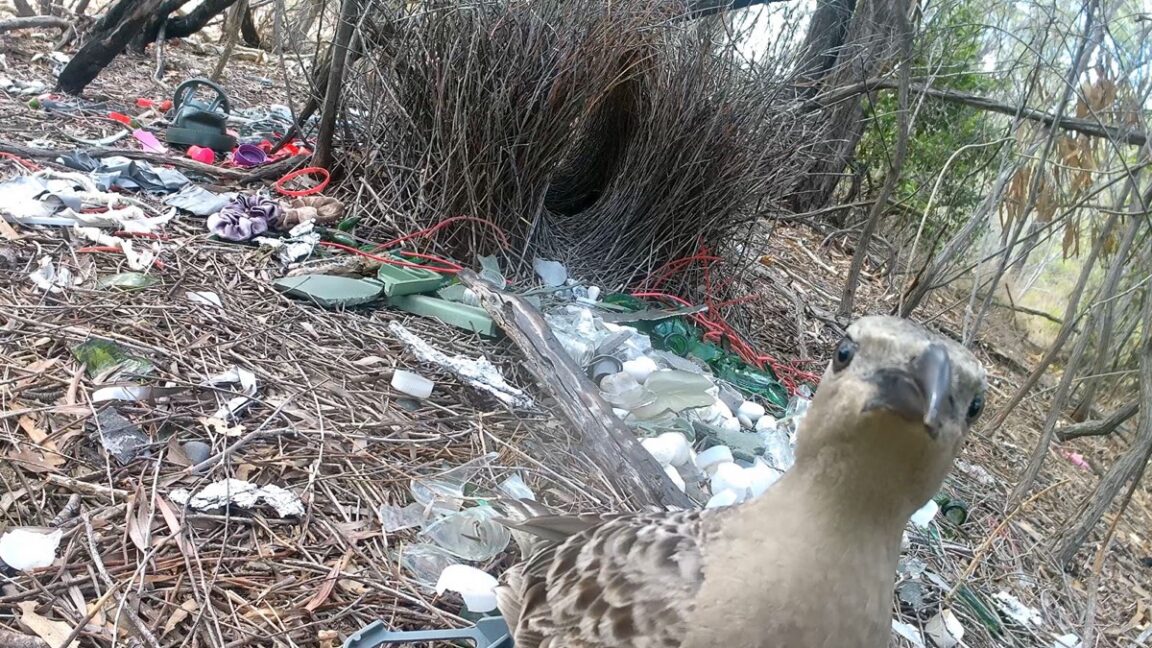
Male great bowerbirds are master architects and interior decorators. They build intricate bowers from twigs and adorn them with colorful objects to attract females. A new study published in *Royal Society Open Science* by University of Exeter researchers reveals a dramatic shift: urbanization is flooding their mating displays with human-made items. The team monitored 61 males across rural (Dreghorn Cattle Station) and urban (Townsville City) sites in Queensland, Australia, during the 2023 breeding season (September–December). They photographed decorations in visible and UV light, since bowerbirds see in the ultraviolet spectrum. The researchers used a calibrated camera system to quantify the spectral reflectance of each object, allowing them to assess how the birds perceive color and brightness.

“Urban bowerbirds now use human trash as their primary courtship tool, with plastic items outnumbering natural objects in over two-thirds of displays. This shift is not merely due to availability; birds actively choose human-made items over natural ones.”
Key Findings
- Decoration composition: Urban bowerbirds used 67% human-made items on average, compared to 23% in rural areas. In some urban bowers, the proportion reached 80%. The most common items were bottle caps, straws, and plastic fragments, but also included glass shards, ring pulls, and pieces of toys.
- UV visibility: Many plastics and brightly colored human objects reflect strongly in UV light, which bowerbirds can see, potentially making them more attractive than natural items. The study found that blue and green plastic items had particularly high UV reflectance, while natural objects like shells and stones had low UV reflectance.
- Active preference: Even when natural objects are available, birds preferentially select human items—suggesting a genuine shift in aesthetic preference, not just availability. In rural areas near roads or settlements, bowers contained more human items than those far from human activity.
- Individual variation: Urban males showed greater diversity in object types, possibly reflecting the wider variety of trash available. Rural males relied more on shells, white stones, and berries. This variation could influence female choice, as females may prefer novelty or specific colors.
Why It Matters
This isn't just a quirky animal behavior story. It's a window into how rapid environmental change—specifically urbanization—can alter fundamental evolutionary processes like sexual selection. If females prefer males with more human-made decorations, then artificial objects are literally shaping the gene pool. This could have unintended evolutionary consequences, such as reducing genetic diversity if females are attracted to a trait that is not linked to male quality. There's also a potential health angle: bowerbirds handle these objects with their beaks, possibly ingesting microplastics or toxic dyes. The long-term fitness consequences remain unknown, but researchers plan to analyze eggs and chicks for microplastic contamination.
Another key implication is the breakdown of honest signaling. In natural settings, decorations like white stones or shells may signal a male's ability to find scarce resources. But if human objects are abundant and easy to obtain in urban areas, the signal loses its informational value. This could lead to a devaluation of ornamentation and reduced selective pressure on foraging ability. Over time, this might alter the evolution of cognitive traits in urban populations.
Your Protocol

For biohackers and nature enthusiasts, this study offers a practical lens to observe evolutionary biology in action. When visiting bowerbird habitats in Australia or New Guinea, you can contribute to citizen science:
- 1Scan bower decorations and categorize them as natural vs. human-made. Use a notebook or a smartphone app to record each item's type, color, and material. Take photos from a consistent distance for later analysis.
- 2Use a UV flashlight to check which items fluoresce. Many plastics and brightly colored objects glow under UV light. Compare the fluorescence of human-made items to natural ones. This can help you understand why birds prefer certain objects.
- 3Note the number of female visits to bowers with high vs. low human-object ratios. Sit at a safe distance (at least 20 meters) and count female approaches over a 30-minute period. This can hint at mate choice preferences. Record the time of day and weather conditions, as these may affect activity.
- 4Share your data on platforms like iNaturalist or eBird. Tag your observations with "bowerbird urbanization" to help researchers track patterns across different regions. If you find unusual objects, report them to the University of Exeter team via their website.

What To Watch Next
Upcoming research will test whether female bowerbirds actively prefer human-made objects in controlled choice experiments. Scientists also plan to analyze microplastic contamination in eggs and chicks from urban vs. rural populations. The results could reveal whether this behavioral shift carries hidden health costs. Another study is examining whether the preference for human items extends to other bowerbird species, such as the satin bowerbird (*Ptilonorhynchus violaceus*), which also builds bowers in urban areas of eastern Australia.
Additionally, researchers are investigating the long-term health effects of plastic exposure on bowerbirds, measuring oxidative stress, immune function, and sperm quality. These studies could have implications for conservation management in urban habitats. If microplastics are found to reduce fertility or survival, it may be necessary to reduce plastic pollution in bowerbird habitats.
The Bottom Line
Urbanization is reprogramming the mating rituals of bowerbirds, turning plastic trash into a tool of seduction. This study is a vivid reminder that our discarded objects have unintended consequences on wildlife behavior and evolution. As we continue to reshape environments, we may be rewriting the rules of attraction—for birds and perhaps beyond. The next time you see a shiny piece of plastic in nature, think of the bowerbird that might be using it to win a mate. And consider how our everyday actions are altering the most intimate evolutionary processes of other species. Citizen science can help document these changes and inform strategies to mitigate the negative impacts of plastic pollution on wildlife.


