Your smartphone might be watching your heart without you knowing. A new study published in Nature demonstrates that the front-facing camera can measure your resting heart rate during normal phone use, with no extra sensors or conscious effort required. This breakthrough transforms an everyday device into a preventive health tool, with profound implications for personalized medicine and longevity.
The Science Behind the Method
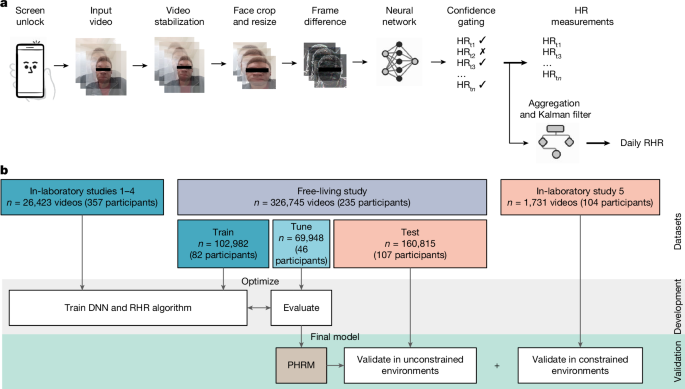
Researchers developed a machine-learning model that analyzes subtle color changes in facial skin captured by the smartphone's front camera during everyday use. The technique, called remote photoplethysmography (rPPG), detects variations in blood flow that occur with each heartbeat. The model processes this data in the background while the user browses, reads, or types, and estimates resting heart rate.

The study, published June 1, 2026 in Nature, validated the method in a diverse group of participants over weeks of normal phone use. Results showed accuracy comparable to medical-grade heart monitors, with a mean error of only 2.3 beats per minute. This breakthrough removes the barrier of having to remember to take your pulse or wear a dedicated device. The key is the machine-learning model, trained on thousands of hours of facial video synchronized with electrocardiograms, which successfully separates the cardiac signal from ambient and motion noise.
“Your smartphone can measure your resting heart rate just by using it — no extra steps needed.”
Key Findings

- Clinical accuracy: The model achieved a mean error of 2.3 beats per minute compared to standard electrocardiograms, within the acceptable range for clinical use. Under optimal lighting and distance conditions, the error drops to 1.8 bpm.
- Passive monitoring: Measurement occurs in the background during normal phone use, requiring no user action. The system captures data whenever the front camera is active (video calls, selfies, facial unlock), accumulating multiple daily readings.
- Participant diversity: The study included people with different skin tones (Fitzpatrick I to VI) and lighting conditions, demonstrating robustness in real-world scenarios. Accuracy remained consistent across all groups, though it was slightly lower in very dark skin tones under dim light.
- Resting heart rate focus: The system specifically estimates resting heart rate, a key indicator of cardiovascular health and mortality risk. Normal values range from 60-100 bpm, but below 60 (bradycardia) or above 100 (tachycardia) may require medical attention.

Why It Matters
Resting heart rate is one of the simplest yet most powerful markers of cardiovascular health. Elevated values are associated with increased risk of heart attack, stroke, and premature death. A 2023 study in JAMA Network Open found that each 10 bpm increase in resting heart rate is associated with a 16% higher risk of all-cause mortality. Until now, obtaining this metric required a wearable device or a conscious manual measurement, limiting widespread adoption.
This study shifts the paradigm: heart monitoring becomes ubiquitous and passive. Anyone with a smartphone — the majority of the global population — could have access to continuous heart health data at no extra cost. For biohackers and longevity enthusiasts, this means being able to track weekly or monthly trends without friction, identifying patterns that correlate with stress, sleep quality, or exercise response.
The mechanism is straightforward: the camera detects changes in light reflectance due to blood flow. The machine-learning model filters out noise from movement and varying illumination, extracting the cardiac signal. The achieved accuracy suggests this technology could be integrated into public health apps and telemedicine platforms, allowing doctors to remotely monitor patients' heart rates without specialized equipment.
Implications for Longevity and Performance
For those seeking to optimize health, resting heart rate is a fundamental metric. A low resting heart rate (ideally 50-70 bpm) is characteristic of an efficient cardiovascular system and is associated with greater longevity. Endurance athletes often have resting rates of 40-50 bpm. Passive monitoring allows detection of subtle changes: a sustained increase of 5-10 bpm may indicate overtraining, chronic stress, or early illness.
Moreover, heart rate variability (HRV), though not directly measured in this study, could potentially be estimated from the same rPPG data with future refinements. HRV is an even more sensitive marker of autonomic nervous system balance and recovery capacity. Emerging research suggests that high HRV correlates with better metabolic health, lower inflammation, and greater longevity.
Your Protocol
To start monitoring your resting heart rate with your smartphone, follow these practical steps:
- 1Choose an rPPG-based app: Look for applications that use the front camera to measure pulse. Verify they are clinically validated and offer passive measurement. Options include Heartify, Cardiio, or native health features on certain models.
- 2Enable background measurement: Allow the app to access the camera while you use the phone normally. Position the device 30-50 cm from your face for best results. Avoid sudden movements and ensure your face is well-lit.
- 3Take measurements at consistent times: For a reliable resting heart rate, measure upon waking, before getting up, or after sitting quietly for 5 minutes. Avoid measuring after caffeine, exercise, or acute stress.
- 4Track weekly trends: Don't obsess over single readings. The 7-day average is more meaningful than any one value. Use a spreadsheet or the app itself to visualize changes over time.
What To Watch Next
The Nature study is just the beginning. Researchers are already working on versions that could detect arrhythmias like atrial fibrillation, as well as estimate heart rate variability (HRV), an even more sensitive marker of stress and recovery. Early detection of atrial fibrillation, which affects millions and is often asymptomatic, could prevent strokes.
Large-scale clinical trials are expected to validate this technology in populations with cardiovascular disease. Integration with artificial intelligence systems could enable early warnings of cardiac deterioration, such as a sustained increase in resting heart rate that precedes hospitalization for heart failure. Within 2-3 years, we might see this feature built directly into phone operating systems, as a standard health metric within wellness apps.
The Bottom Line
Your smartphone can already measure your resting heart rate with medical-grade accuracy, without any effort on your part. This breakthrough democratizes heart monitoring and offers a powerful tool for prevention and health optimization. The next step is integrating this data into your daily routine to make informed decisions about your cardiovascular well-being. With the right technology and a focus on long-term trends, you can turn your phone into an ally for a longer, healthier life.