
The gravitational constant, affectionately known as "Big G," is one of the most fundamental constants in the universe. It describes the strength of the gravitational force between two masses. For over two centuries, physicists have tried to measure it with ever greater precision, but each effort yields slightly different values. The variation is tiny: about 1 part in 10,000. Yet other fundamental constants, such as the speed of light or Planck's constant, are known to accuracies of up to 12 orders of magnitude better. Big G is the black sheep of the family, a frustration for precision metrologists. The problem is that gravity is the weakest of the four fundamental forces: the electromagnetic force is about 10^36 times stronger. Additionally, background noise from Earth's gravitational field ("little g") interferes with lab measurements, making any experiment extremely sensitive to vibrations, temperature changes, and movements of nearby masses. In the latest attempt to resolve the issue, scientists at the National Institute of Standards and Technology (NIST) spent a decade replicating one of the most divergent recent results, obtained in 2014 by a team at the University of Zurich. Their study, published in Metrologia, does not resolve the discrepancy but adds a crucial data point in the quest for a more precise Big G. The scientific community hopes that with enough data, they can identify whether the variation is due to uncontrolled systematic errors or to new physics that challenges the Standard Model.
The Science
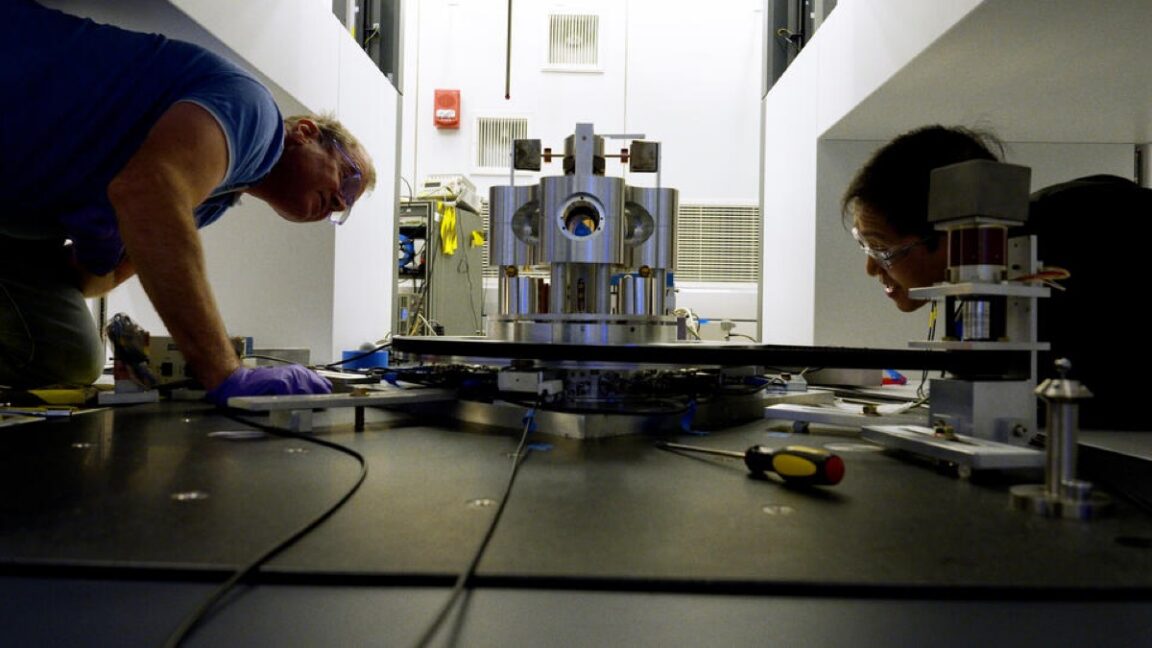
Gravity is extraordinarily weak. To put it in perspective, the electromagnetic force is about 10^36 times stronger. This means measuring Big G in a lab is like trying to hear a butterfly's wingbeat in a hurricane. Earth's own gravitational field, "little g," creates background noise that contaminates measurements. Experiments must be isolated from vibrations, temperature changes, and any external interference. Yet results still vary. The most common methods include torsion balances, where a mass suspended from a wire is attracted by another mass nearby, and free-fall experiments, where the acceleration of objects in vacuum is measured. Each technique has its own sources of error: in torsion balances, wire stiffness and air currents; in free-fall experiments, timing precision and vacuum quality.


:format(jpg):quality(99):watermark(f.elconfidencial.com/file/a73/f85/d17/a73f85d17f0b2300eddff0d114d4ab10.png,0,275,1)/f.elconfidencial.com/original/bff/55e/bad/bff55ebad8fb5e56dd931f4d292a779c.jpg)

:format(jpg):quality(99):watermark(f.elconfidencial.com/file/a73/f85/d17/a73f85d17f0b2300eddff0d114d4ab10.png,0,275,1)/f.elconfidencial.com/original/cc4/264/a24/cc4264a24dd35d9b43fd360db1a67dae.jpg)