
A planet 690 light-years away has morning clouds and clear evenings. That might not sound revolutionary until you realize that astronomers have been averaging exoplanet atmospheres for years—and getting the chemistry wrong. The James Webb Space Telescope (JWST) just mapped the weather on WASP-94A b, a hot gas giant in a binary system, and the findings are a wake-up call for how we interpret atmospheric data. But the lessons don't stop at astronomy: they extend to how we track our own health, where averages can be just as misleading.
The Science
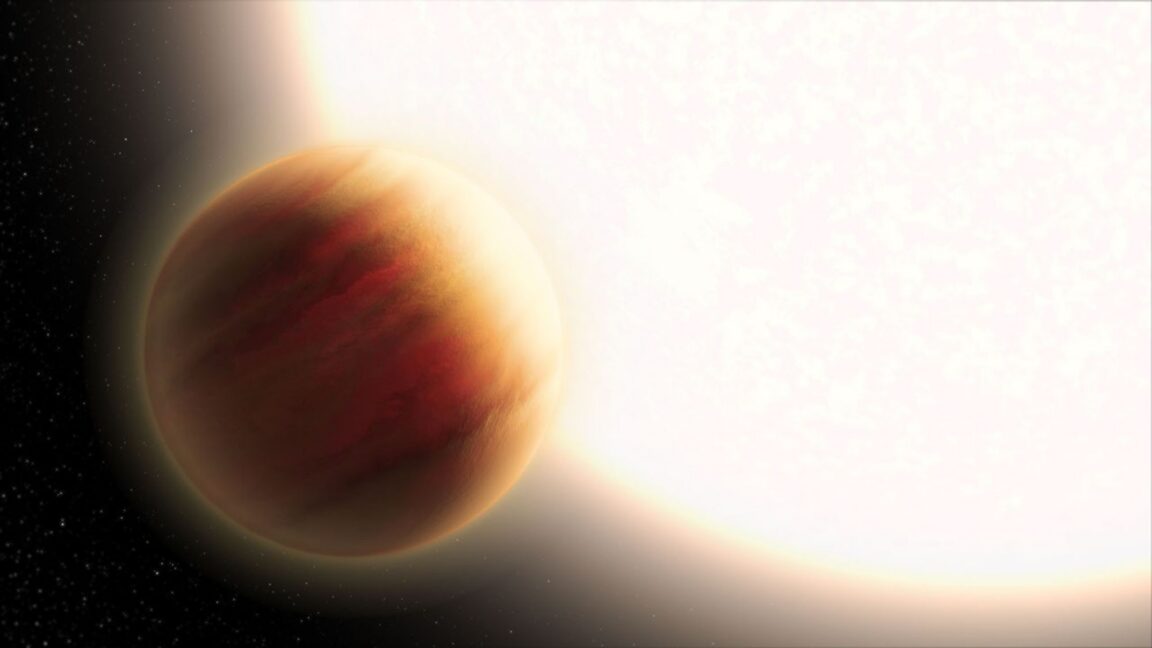
WASP-94A b is a tidally locked planet with a mass less than half of Jupiter but a diameter over 70 percent wider. This low density means its atmosphere is puffy and easy to study. A team led by Sagnick Mukherjee at Johns Hopkins University used JWST's transmission spectroscopy to analyze starlight filtering through the planet's atmosphere as it transits its host star. The goal: understand whether the atmosphere is static or dynamic, and whether it has winds or clouds.

What they found defies the standard approach. Instead of a uniform atmosphere, the planet shows stark differences between its morning and evening sides. "We wanted to understand the atmospheres of such planets. Are they static or dynamic? Do they have winds? Do they have clouds?" Mukherjee says. The answer: yes to clouds—but only in the morning. By evening, the skies are clear. This implies that averaging the atmosphere across the entire planet masks real chemical variations. The team used data from multiple transits to separate the dawn and dusk signals, a technique requiring extreme precision that only JWST can achieve.
“The weather on an exoplanet 690 light-years away reveals that our averaged atmosphere models may be hiding the true chemistry.”
Key Findings

- Morning clouds, clear evenings: JWST detected cloud signatures on the dawn side of the planet, while the dusk side showed clear skies. This suggests complex circulation patterns, likely driven by winds transporting heat from the day side to the night side.
- Extreme density: With a mass <0.5 Jupiter and diameter >1.7 Jupiter, WASP-94A b has very low density, making its extended atmosphere easier to observe. This low density also implies the atmosphere is more susceptible to gas loss, which could affect its long-term evolution.
- Transmission spectroscopy: The technique analyzes light filtered through the atmosphere during transit, revealing chemical composition in different regions. By separating dawn and dusk data, researchers could map cloud and gas distributions.
- Model implications: Global average models may underestimate cloud cover and overestimate certain compounds, altering interpretations of habitability. For example, averaging water signals could lead to concluding there is less water vapor than actually exists on the clear side.

Why It Matters
This finding isn't just about exoplanet meteorology. If astronomers have been using models that average the atmospheres of planets like WASP-94A b, they may have misread the chemistry of hundreds of exoplanets. For instance, the presence of water, methane, or carbon dioxide could be biased if day-night or morning-evening differences aren't accounted for. A 2025 study from the University of Chicago had already suggested that averages could hide true atmospheric diversity, but this is the first confirmed case with high-resolution data.
For the search for life, this is critical. Biosignatures like oxygen or methane could appear or disappear depending on what time of day you observe. Moreover, understanding atmospheric dynamics helps refine climate models for potentially habitable exoplanets. JWST, with its ability to resolve fine details, becomes an indispensable tool for not just detecting molecules but mapping weather in three dimensions. NASA has already announced that JWST will dedicate an additional 500 hours in 2026-2027 to study atmospheric variability on a dozen exoplanets, including some in the habitable zone.
Your Protocol
While you can't travel 690 light-years, this study reminds you that averages lie. In your own health, aggregated data (like average heart rate) can hide important spikes. Here are three practical lessons:
- 1Don't trust averages: Like WASP-94A b's atmosphere, your body varies throughout the day. Measure biomarkers (glucose, blood pressure, cognitive performance) at different times for a real picture. For example, fasting glucose may be normal, but postprandial spikes could indicate insulin resistance.
- 2Look for temporal patterns: Just as astronomers found morning clouds, you can identify if your energy, mood, or digestion follows a circadian rhythm. Adjust your diet or exercise accordingly. If your energy dips in the afternoon, schedule cognitively demanding tasks for the morning.
- 3Use high-resolution tools: Just as JWST reveals details older telescopes couldn't, next-gen wearables (continuous glucose monitors, sleep rings, ECG patches) give you more precise data than a scale or step counter. Invest in devices that record data every few minutes, not just daily averages.
What To Watch Next
Mukherjee's team plans to apply this technique to other hot Jupiters and eventually super-Earths in habitable zones. The next generation of telescopes, like the Extremely Large Telescope (ELT), will map atmospheres in even greater detail. JWST is also expected to study cloud variability over time on multiple exoplanets, helping build 3D climate models.
Researchers are also developing algorithms to correct the bias of averaging atmospheres. This could change how we interpret data from missions like TESS and JWST itself. The search for extraterrestrial life may depend on not falling into the same trap we did with WASP-94A b. In the health space, companies like Levels and Oura are already applying similar principles to offer personalized recommendations based on high-resolution temporal data, not averages.
The Bottom Line
JWST has given us a humility lesson: even the most accepted models can be wrong if we ignore local variability. On a planet where it's always morning on one side and evening on the other, chemistry changes drastically. For biohackers and health optimizers, the takeaway is clear: measure in context, not on average. The future of diagnosis and prevention lies in high-resolution temporal data, not daily means. Just as astronomers now know to look beyond the average, we must do the same with our bodies.
:format(jpg):quality(99):watermark(f.elconfidencial.com/file/a73/f85/d17/a73f85d17f0b2300eddff0d114d4ab10.png,0,275,1)/f.elconfidencial.com/original/74d/0df/4ec/74d0df4ec02cc49a09b24ff79766878d.jpg)
:format(jpg):quality(99):watermark(f.elconfidencial.com/file/a73/f85/d17/a73f85d17f0b2300eddff0d114d4ab10.png,0,275,1)/f.elconfidencial.com/original/aa0/b3c/6c1/aa0b3c6c10bc4830f1a7f98028bbc49f.jpg)
